Saturday, September 05, 2009
Interesting bed questions
Monday, August 31, 2009
A grip of the Euro-blogosphere (updated)
Thursday, August 27, 2009
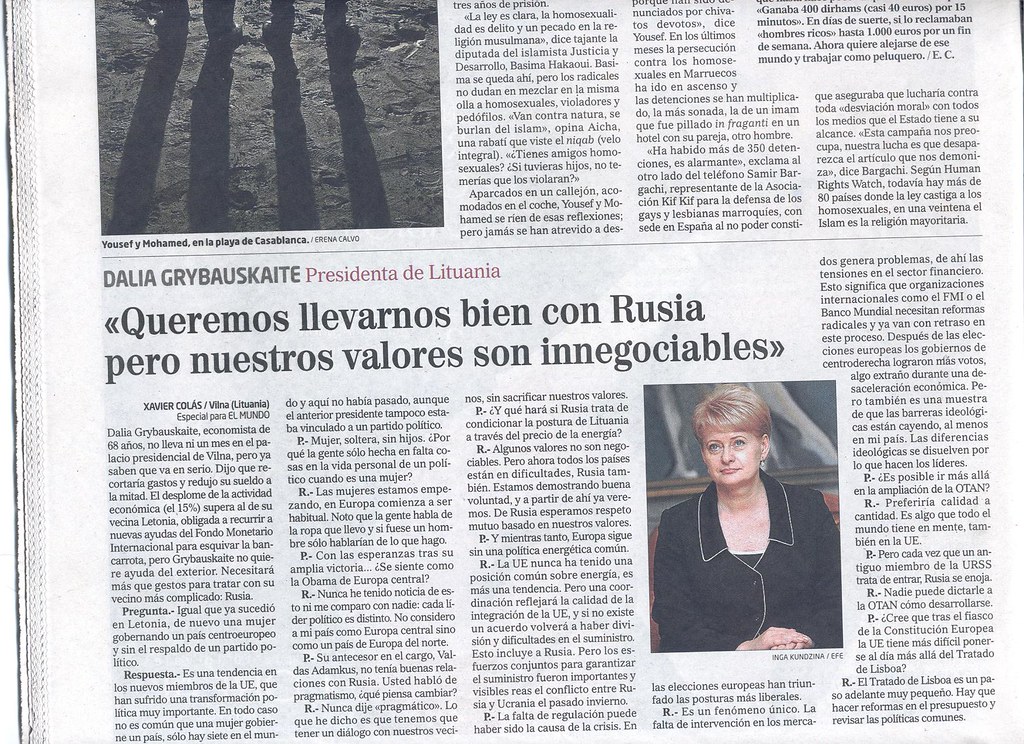
"I don't feel the 'Obama' of Central Europe"
Dalia Grybauskaite, economist at 53, not even a month has been installed at the presidential palace in Vilnius (Lithuania) but she has managed to at least show that it is serious. He said she would cut costs and started for his salary, which halved. But after the cuts have come to the officials and all kinds of expenses. Their determination coupled with small gestures such as his official car stops at traffic lights to Grybauskaite can win the trust of many, something essential in a country which has fallen 15% this year. The slump in economic activity surpasses that of its neighboring Latvia, forced to tap new IMF aid to avoid bankruptcy. But Grybauskaite, former European commissioner and a black belt in karate, does not want outside help. Although certainly need more than gestures to treat more complicated with its neighbor, Russia. Text I published in EL MUNDO, (in spanish) here
-Just as happened in Latvia, once a woman ruling a country in Central Europe, and again he succeeds without the support of a political party.
-It's a trend in the new EU members, who have suffered a major political transformation. In any case it is uncommon for a woman governs a country, there are only seven in the world and Lithuania never happened, although the former president also was related to a political party.
-But he was very involved in the secession of Lithuania in the 90's. And you don't.
-Everybody is different. It has been 20 years since that and probably more people are looking forward rather than backward. I do not want to evaluate why they trusted me, but the devaluation of the quality of politicians I think that was one reason.
-Woman, single, no children. Why people just need things done in the personal life of a politician when is a woman?
-Women are starting, but in Europe is becoming commonplace. Somehow most interesting results to discuss us, I notice that people talk about the clothes on my man and if only speak of what I do.
-Does you feel like the Obama of Central Europe?
-I have never had this news not compare myself to anyone, every political leader is different. And my country do not regard as central Europe but as a country of northern Europe.
- Are you a feminist?
-Depends on what we call a feminist. I've never participated in any of those movements.
-Your predecessor, Valdas Adamkus, didn't had good relations with Russia, and you have advocated a more pragmatic stance. What will change?
-I never said "pragmatic", that was an interpretation of my words. What I have always said is we have to have a constructive dialogue with our neighbors, of course without sacrificing our values.
- What will you do if Russia is to condition the position of Lithuania through the price of energy?
-I've said that some values are not negotiable.
-You are not the first, they tried other presidents before and this new relationship with Russia was not possible.
-Now all countries are in difficulties, Russia too. And both there and here there are political forces that seek to divert attention from problems for a common enemy. We are showing goodwill, and from there we'll see. Russia expect mutual respect based on our values.
-And meanwhile Europe remains wihout a common energy policy.
-The EU has never had a common position on energy, not on the treaties. It is more a necessity, a trend. But coordination is necessary to reflect the quality of EU integration, and if no agreement will be split and supply difficulties, and that includes Russia. But the joint efforts to ensure the supply were very important and very visible after the conflict between Russia and Ukraine last winter. It is an evidence that such coordination is important, but still a long way to go.
-The global crisis may be triggered by lack of regulation, but in the European elections have won just more liberal positions.
-It's a unique phenomenon. A lack of international intervention in financial markets has created many problems for the world, hence the stresses in the financial sector. This means that international regulatory organizations like the IMF or the World Bank need to be radically reformed and already lagging behind in this process. But in each member country the situation is quite different. After the election we can say that European governments were able to center the most votes, which is very unusual in a downturn. But it is also a sign that the ideological barriers are falling, at least in my country. The political powers do not behave in a purely ideological: some more leftist governments to protect companies and other center-right people are protecting more than the Social Democrats, at least in my country. The ideological differences are being dissolved by what leaders do.
-It seems that this crisis makes the euro more attractive to both Lithuania and more inaccessible.
-Yes, because for me the euro is not just a currency but monetary discipline that prevents governments are populist tax policy and this is a guarantee for the stability of countries. But certainly in a slowdown situation will be very difficult to achieve in the next three years because of the stability pact criteria are stringent. But if there were no euro in Europe would be worse off.
-Your country has benefited from European cohesion funds. But you refuse to seek help from the "rescue funds" from the IMF.
-There are no bailout funds. There are funds that can borrow, but with many conditions.
In practice, this means you are leaving for an outsider to dictate your entire economic policy because the government does not know how to deal with the situation. I do not want my country to be treated as if it were not capable of governing. We know what we do: we are cutting public spending on wages, investing in infrastructure to stimulate the economy. We are sinking and need outside help, we can rescue ourselves.
- Is it possible to go further enlargement of NATO?
-Probably yes but I prefer quality to quantity, not only to expand expand. But it's something everyone has in mind, also in the EU, which wants to enter Iceland.
-But every time a former member of the USSR into Russia is angry.
-Nobody can dictate to NATO and develop.
- Do you think that after the fiasco of the European Constitution EU is more difficult to catch up beyond the Lisbon Treaty?
-The treaty of Lisbon is a small step forward, talks about how to make decisions but does not reform. We must make reforms in the budget and review common policies and all or that determines the quality of integration.
-You've been commissioner of the Budget. As a Lithuanian citizen have you got the feeling of arriving in the EU when there is less desire to redistribute to those with less?
-For new members the EU is not just money, but political, security and freedom of movement. Of 27 members, 21 are still receiving. But for us it was not just money but freedom.
-The Lithuanians were not just as enthusiastic of the EU in June. It was the country where fewer people voted.
-In Lithuania has always been low participation in European elections. It is a question of political culture and lack of information, plus the votes were weeks after the presidential election. But somehow the everyday people at home, not in Brussels or Strasbourg.
Sunday, August 16, 2009
Polish immigrants leaving Britain: What the Poles did for UK
Thursday, July 30, 2009
No question of "what Obama can do for us, but what we can do for Obama"
Friday, July 03, 2009
Time to remember, USSR in the 70´s
A great collection of photos of a world that will never come back.
Sunday, April 05, 2009
Saturday, March 14, 2009
Los in transition
Key Conclusions:
- To avoid becoming a lame duck president, Putin will seek to perpetuate the uncertainty and suspense around the election and his own political future. Putin's recent reshuffling of his cabinet and the appointment of a relatively unknown prime minister demonstrated his need to prove he is still in charge. A new struggle for control and influence over the incoming political regime is likely to emerge.
- Russia's next leader must address the pressing social problems plaguing the nation, notably population decline and economic disparity. While anti-Western rhetoric has distracted the public, Russia's shattered social infrastructure threatens economic and social stability.
- Russia's recent assertiveness in foreign policy has greatly mobilized the public, and the ruling elite would like Russia to simultaneously be both friend and foe to the West. Potential domestic crises in Russia could result in a more nationalist and authoritarian regime that eschews cooperation with the West and purges moderates from the Kremlin.
- To create a fertile environment for Russia's further economic and political transformation, Russia and the West must recognize that they have common interests rooted in shared values. Western policy towards Russia should avoid isolation at all costs and should be based on understanding, strategy, and engagement.
- In particular, Western nations must understand Russia's unique dilemmas and choices;
- develop a coherent strategy addressing the Kremlin leadership, the political class, and society;
- and engage with Russia on areas where their interests overlap—counter-proliferation, combating international terrorism, energy security, and climate change—but not at the expense of acquiescing to the crackdown on democracy.
"Perhaps the greatest challenge for transforming Russia will be the need for its leadership to start the new reforms, of which the most radical will be dividing state power among independent institutions. Will a new leader be prepared to embark on political self-castration and hand over some of his power to other institutions? This is Russia's metaproblem for which no solution was found under Yeltsin and Putin," concludes Shevtsova.
Monday, March 09, 2009
"Nasing spesal..."
Thursday, March 05, 2009
Stalin no better than Hitler?
Wednesday, January 21, 2009
Obama´s words
Monday, January 12, 2009
Bad cold
Sunday, January 04, 2009
Things we watch
Israel released video of an air attack on 28 December, which appeared to show rockets being loaded onto a lorry. The truck and those close to it were then destroyed by a missile. The YouTube video has a large caption on it saying "Grad missiles being loaded onto the Hamas vehicle." But a 55-year-old Gaza resident named Ahmed Sanur, or Samur, claimed that the truck was his and that he and members of his family and his workers were moving oxygen cylinders from his workshop. Mr Sanur said that eight people, one of them his son, had been killed.
Israeli human rights group B'Tselem put Mr Sanur's account on its website, together with a photograph of burned out oxygen cylinders. According to Sanur’s testimony, he and members of his family were trying to salvage material from a metal workshop he owns, which was next door to a bombed house, in order to prevent looting. He denies any connection to militants, or military activity, and is willing to talk to any journalist, or investigator.
Thanks to Andrius for sending the story.
Saturday, January 03, 2009
Freezing again
Bohdan Sokolovsky, an energy adviser to Viktor Yushchenko, Ukraine's president, said the European Commission had shown "understanding" during talks. However, Oleksandr Hudyma, energy adviser to Yulia Tymoshenko, Ukrainian prime minister, said unwillingness to confront Russia was "no surprise. Ukraine does not have any misconceptions about the support it would get from [the] European Union, which showed itself during the Georgian conflict."
Friday, January 02, 2009
Russia after de gulag
Theotherrussia.org provides a roundup of news stories coming out of Russia’s prisons and penal colonies, which are notorious for cruel treatment and arbitrariness.
NYT presents an slide show about russian jail that reveals aspects of the country's contradictory penal system. Russia jails a greater proportion of its people than any other major country apart from the US. According to the 2006 figures from the Russian Government, there are 829,000 people serving prison sentences.
As Lev Ponomarev, from the Movement For Human Rights, told the BBC the regime itself is the real issue now, a system he says which can lead to a culture of cruelty.
Some interesting facts about criminal tatoos in russian prisons.
Promises to keep... fighting for
On this day nine years and one day ago, Vladimir Putin was sworn into office.
Putin said in the address:
'Freedom of speech, freedom of conscience, freedom of the mass media -- these basic freedoms will be reliably protected by the State,'
Thanks to Robert Amsterdam for reminding it.
2009 oh yea(r)!
- Both 2009 and its reversal 9002 are multiples of 7.
- The 2009th prime (17471) is palindromic.
- You can express 2009 as the sum of 4 positive cubes in exactly 3 ways.
Wednesday, December 31, 2008
Obama´s never gonna tell a lie and hurt you...
In 2007 Rick Astley became the subject of a viral Internet meme in which an estimated 25 million Internet users were tricked into watching Rick Astley's video "Never Gonna Give You Up" by posting it under the name of other popular video titles. The practice is now known as Rickrolling. The phenomenon became so popular that on April 1, 2008, YouTube pranked its users by making every single featured video on the front page a Rickroll.
Here is Omaba singing. And lyrics here.
By the way. Also McCain dances.
Thursday, December 25, 2008
17 killed in Ukraine explosion
No ready for the (b)east?
Lubos Palata writes in Transitions Online about how the EU offers a new deal to the countries on its eastern frontier, and an implicit challenge to Russia .In the eyes of Eastern Europeans, the European Union is a standard measure for quality – the quality of products, of democracy, of housing, of lifestyles. Not America or Japan, but Europe. Millions of Ukrainians, Georgians, Azerbaijanis and Belarusians dream of one day living as people do in the EU. Those who can afford it actually act on those dreams. Cities like Berlin, Vienna, Karlovy Vary and Nice are full of rich Eastern Europeans who have used the millions they made in the east to move west and live the "eurolife."
Lubos Palata is the Central and Eastern European editor for the Czech daily Lidove noviny and a contributor to the Polish daily Gazeta Wyborcza and the German monthly German Times. He thinks that the problem is that the EU doesn't want Eastern Europe. It is already having a hard time digesting the 12 new member-states – including 10 from the post-communist regions of East-Central Europe and the Balkans – that were added to the union in recent years.
"This difficulty is evident in the rejection of the European constitution and the difficulties surrounding the Lisbon agreement"
sitemeter