Michael Stipe, lead singer of R.E.M., spent a great deal of time explicating on Thursday night, good-naturedly turning Madison Square Garden into a lecture hall, writes NYT. Before the final song, Mr. Stipe couldn’t quite help but offer one last mini-sermon. “This,” he said of “Disturbance at the Heron House,” from 1987, “is my rewriting of the novel ‘Animal Farm.’ ” “Ignoreland,” from 1992, was his “barely adult reaction to the Iran-Contra scandal.” And “Man-Sized Wreath,” from this year’s album “Accelerate”(Warner Brothers), was inspired, he said, by the day in 2004 when, met by several hundred protesters, President Bush visited — or, in Stipe’s description, desecrated” — the grave of the Rev. Dr. Martin Luther King Jr. “George W. Bush is a pathetic idiot,” he said, then looked forward: “I feel very, very hopeful with 2008.” How that optimism, not historically R.E.M.’s strong suit, will translate into song remains to be seen.
Saturday, June 21, 2008

Lithuania was OK...upied
Again, Lithuania has angered Russia. This time by proposing a bill that would prohibit the public from displaying Soviet symbols, including the red flag with a hammer and sickle and the national anthem. Not so long ago, soviet simbols were not rare in Vilnius. And National Anthem of Lithuanian Soviet Socialist Republic survives on the world wide web.
This ban includes flags, emblems and badges carrying insignia, such as the hammer and sickle or swastika.
National Anthem of Lithuanian Soviet Socialist Republic
In fact, Lithuanian SSR was first proclaimed on December 16, 1918, by the First Congress of the Lithuanian Communist Party supported by bolshevik armed forces. It failed to create a de facto government with any popular support.The Lithuanian SSR was first proclaimed on December 16, 1918, by the First Congress of the Lithuanian Communist Party supported by bolshevik armed forces. It failed to create a de facto government with any popular support.
What happened later, was not a jocke. The Molotov-Ribbentrop Pact of (August 1939), between Nazi Germany and the Soviet Union, stated that Lithuania was to be included into the German "sphere of influence", but after the World War II broke out in September 1939 was amended to transfer Lithuania to the Soviet sphere in exchange for Lublin and parts of the Warsaw province of Poland, originally ascribed to the Soviet Union, but by that time already occupied by German forces. The Lithuanian Soviet Socialist Republic was established on July 21, 1940.
The United States, United Kingdom, and other western powers considered the occupation of Lithuania by the USSR illegal, citing the Stimson Doctrine, in 1940, but recognized all borders of the USSR at post-World War II conferences.

Several waves of deportations affected Lithuania. only in July 12-16, 1940 more than 500 people were arrested - most of them were public men and politicians, army officers, office employees of the independent Lithuania. In the short run, among the dangerous enemies of the Soviet system were reckoned ordinary members of legal parties, organizations that existed in independent Lithuania, police officers, teachers and even Esperantists and philatelists. The repressive departments established pursuing the example of the Soviet Union took into their disposition Lithuanian archives and looked for the "anti-Soviet elements".
The first mass deportation began on June 14, 1941, at night. People realizing nothing were woken up, sat into lorries and conveyed to the nearest railroad station. Thousands of people woken up from sleep (women, children and old people) were told to leave their homes in a hurry.
The Lithuanian SSR was renamed the Republic of Lithuania again, and on March 11, 1990, all legal ties of sovereignty were cut with the Soviet Union as Lithuania declared the restitution of its independence. The government of the USSR recognised Lithuania's independence one year later.
Till then some rock groups sang "Lietuva yra OK OK OK!" (ok... occupied)
Moscow's official interpretation of history is that Lithuania, Latvia
and Estonia were liberated from Nazi Germany by, then voluntarily
joined, the Soviet Union.
In comparison with other parts of the USSR its economy fared better and
today Lithuania remains one of the wealthiest of the formerly
Soviet-controlled states.
These are the toughest bans on symbols from the Soviet past adopted in any of the 15 countries that emerged from the USSR.Correspondents say equating Soviet and Nazi symbols in this way is certain to infuriate Russia, BBC reports.
This ban includes flags, emblems and badges carrying insignia, such as the hammer and sickle or swastika.
National Anthem of Lithuanian Soviet Socialist Republic
In fact, Lithuanian SSR was first proclaimed on December 16, 1918, by the First Congress of the Lithuanian Communist Party supported by bolshevik armed forces. It failed to create a de facto government with any popular support.The Lithuanian SSR was first proclaimed on December 16, 1918, by the First Congress of the Lithuanian Communist Party supported by bolshevik armed forces. It failed to create a de facto government with any popular support.
What happened later, was not a jocke. The Molotov-Ribbentrop Pact of (August 1939), between Nazi Germany and the Soviet Union, stated that Lithuania was to be included into the German "sphere of influence", but after the World War II broke out in September 1939 was amended to transfer Lithuania to the Soviet sphere in exchange for Lublin and parts of the Warsaw province of Poland, originally ascribed to the Soviet Union, but by that time already occupied by German forces. The Lithuanian Soviet Socialist Republic was established on July 21, 1940.
The United States, United Kingdom, and other western powers considered the occupation of Lithuania by the USSR illegal, citing the Stimson Doctrine, in 1940, but recognized all borders of the USSR at post-World War II conferences.
Several waves of deportations affected Lithuania. only in July 12-16, 1940 more than 500 people were arrested - most of them were public men and politicians, army officers, office employees of the independent Lithuania. In the short run, among the dangerous enemies of the Soviet system were reckoned ordinary members of legal parties, organizations that existed in independent Lithuania, police officers, teachers and even Esperantists and philatelists. The repressive departments established pursuing the example of the Soviet Union took into their disposition Lithuanian archives and looked for the "anti-Soviet elements".
The first mass deportation began on June 14, 1941, at night. People realizing nothing were woken up, sat into lorries and conveyed to the nearest railroad station. Thousands of people woken up from sleep (women, children and old people) were told to leave their homes in a hurry.
The Lithuanian SSR was renamed the Republic of Lithuania again, and on March 11, 1990, all legal ties of sovereignty were cut with the Soviet Union as Lithuania declared the restitution of its independence. The government of the USSR recognised Lithuania's independence one year later.
Till then some rock groups sang "Lietuva yra OK OK OK!" (ok... occupied)
Moscow's official interpretation of history is that Lithuania, Latvia
and Estonia were liberated from Nazi Germany by, then voluntarily
joined, the Soviet Union.
In comparison with other parts of the USSR its economy fared better and
today Lithuania remains one of the wealthiest of the formerly
Soviet-controlled states.
These are the toughest bans on symbols from the Soviet past adopted in any of the 15 countries that emerged from the USSR.Correspondents say equating Soviet and Nazi symbols in this way is certain to infuriate Russia, BBC reports.
Monday, June 09, 2008
Coal and tragedy
5 Injured, 37 Missing in Yenakiyevo Coal Mine Blast, Ucraniana blog reports. A massive methane explosion at a coal mine in Yanakiyevo, Donetsk oblast, comes less than a week after the recovery of 11 bodies from the May 23 accident at the Krasnolymanska mine.
Sunday, June 08, 2008
Liberals. Or not.
Russia's economic stability and ability to establish itself as a leading global economy is at the heart of a debate in government, with the liberal faction represented by Finance Minister Alexei Kudrin arguing that the economy is expanding at unsustainable levels, Moscow Times reported.
Jim O'Neill, chief economist at Goldman Sachs, said his bank predicts that Russia will be one of the leading eight economies by 2020, up from 10th place now, as the rapid jumps in the oil price slow down over the next decade.
Elvira Nabiullina, Economic Development Minister, who was moderating the session and is one of the government's keenest proponents of accelerated economic growth, accused him of "forecasting inertia."
Igor Shuvalov, First Deputy Prime Minister, showed more interest in policy than the intricacies of economic measurement, arguing that the government should take a liberal tack and step back from interfering in the economy if it is to modernize: We have to repeat again and again — the protection of property rights is the top and most important task for the state," he said.
Alireza Ittihadieh said that "Medvedev wanted to emphasize that past and present have nothing to do with each other," , She is CEO of British aviation company Freestream Aircraft, said following the meeting. "The summary of the whole thing was — this is me and this is not somebody else. The country's leadership is changed, so what I am saying is not what my predecessor said … He seemed to be trying to be more open-minded and to move things forward."
A hug? Not now, thanks.
Russian President Dmitry Medvedev delivered an extensive speech to German politicians and businessman during his visit to Germany. It became Medvedev’s first landmark public appearance of international significance. The speech clearly showed which problems the new Russian president considered as vital. One of the most talked-about subjects – the deployment of the US missile system in Eastern Europe and the expansion of NATO – became one of the most important aspects in Medvedev’s speech:
The president argued for the removal of barriers for Russian companies looking to invest overseas, stressing that its outward investment is neither "speculative nor aggressive." Existing global institutions are becoming obsolete, he said, demonstrating their inability to tackle pressing global problems like rising food prices.
“It is very indicative that discrepancies with Russia are interpreted by many in the West from the point of view of the need to pull Russia’s stance to that of the West. We do not need to be hugged. We are seeking after truly equal relations and nothing more”
The president argued for the removal of barriers for Russian companies looking to invest overseas, stressing that its outward investment is neither "speculative nor aggressive." Existing global institutions are becoming obsolete, he said, demonstrating their inability to tackle pressing global problems like rising food prices.
Sunday, June 01, 2008
Is this girl the most beautiful of Russia?
 Ksenia Sukhinova, 20 years old, was officially crowned "Miss Russia 2007." She won also won $100,000 and the right to represent Russia at "Miss Universe," the international beauty contest. She is from from Tyumen, where she is a student in the department of "Technical Cybernetics" at Tyumen University of Oil and Gas.The last Miss Russia to win Miss Universe was Oksana Fedorova in 2002.
Looking as a president (but he is a prime minister)
 Vladimir Putin began his first major international visit since becoming prime minister son Thursday, meeting with officials in Paris to conduct negotiations on a presidential scale, the newspaper Kommersant said.
Though there is nothing strange about a Russian prime minister taking a role in foreign affairs, Mr. Putin "is not simply a prime minister," a source from France's Foreign Ministry said. The ministry has had to improvise on diplomatic protocol and President Nicolas Sarkozy prepared to discuss several issues not typically covered with visitors of Mr. Putin's official rank: like, for example Russia's political relationship with the European Union, a subject usually reserved for the Russian president.
Russian press is fond of that. Sarkozy, who is on a first-name basis with Putin and addresses him in the familiar "tu" form, greeted him at his car as it pulled up to the palace, as Moscow Times pointed out. Sarkozy, who is on a first-name basis with Putin and addresses him in the familiar "tu" form, greeted him at his car as it pulled up to the palace. (As president, the only countries Putin visited more than France were Ukraine, Kazakhstan, Belarus and Germany. He made seven visits to France, and his Friday schedule was to begin with a meeting with the man who usually played his host)
Thursday, May 08, 2008
President Medvedev
In his first speech as head of state, newly inaugurated President
Dmitry Medvedev vowed to strengthen the rule of law and to
bring as many Russians as possible into the middle class. The ceremony, mixing czarist splendor with renewed Russian confidence, served as a tribute to the enduring stature and popularity of Putin, whom Medvedev nominated as prime minister within hours of
taking office.
Sunday, April 20, 2008
"быстро! ...si vous plait"

Meat after all, yes. But this word souds familiar for all russian speakers. Even for those frome the first level: "Where did I heard this?"
Bistro as a concept was developed in Paris. Bistros are restaurants defined mostly by the foods they serve. The word "bistro" may come, , if we believe the urban legend, from the Russian быстро (bystro) which means quick. According to an urban legend, it entered the French language during the Russian occupation of Paris in 1815. Cossacks who wanted to be served quickly would shout "bistro!".
Is this true? Larousse Gastronomique, the world's ultimate culinary encyclopedia, states that the word bistro did not appear in the French language until 1884, nearly seventy years after the Russians had left. The most likely origin is doubtless an abbreviation of the word bistrouille, a French slang word for a mixture of coffee and cheap brandy once served at such places. So writes bistrosets.com, whose autority in this subject I can not discuss.
(Image: "At the Bistro," Jean Beraud)
Putin likes all women, not only Kabayeva
 Russian President Vladimir Putin turned a reporter's question about his marriage into a discourse on female beauty, saying Friday that "I like all Russian women." Putin praised his countrywomen in response to a reporter's question about a recent tabloid report that claimed he intends to marry a former Olympic gymnast less than half his age.
"There is not a single word of truth" to the report, Putin said at a news conference in Sardinia with incoming Italian Premier Silvio Berlusconi.
"Putin divorced", The Moscow tabloid, Moskovsky Korrespondent, reported.
Kabayeva, who won a gold medal at the 2004 Summer Games, is now a member of the lower house of Russia's parliament from the pro-Kremlin party. The tabloid report, which was published April 12, has been largely ignored in the Russian press. But it's received wide play in many European newspapers.
"I have always had a negative opinion of those who, with their snotty noses and their erotic fantasies, meddle in other people's lives," he said.
Sunday, April 13, 2008
The Independent: "Russian town is so toxic even the mayor wants it closed down "
The residents of many Russian towns might feel that they have cause for complaint. But in Chapayevsk, a town of about 70,000 inhabitants in European Russia, the mayor himself has suggested a novel way of solving the town's problems – abandon it. According to The Independent, you can hardly blame him – 96 per cent of all children there are deemed unhealthy.
Chapayevsk, close to the Volga river and the city of Samara, is home to factories that produced chemical weapons for many years, and is blighted by air and soil pollution. According to the newspaper Nezavisimaya Gazeta, at a round table meeting on the environment in Samara this week, the town's mayor, Nikolai Malakhov, said that resettling the town's residents would be an "ideal solution" to Chapayevsk's problems"
Chapayevsk, close to the Volga river and the city of Samara, is home to factories that produced chemical weapons for many years, and is blighted by air and soil pollution. According to the newspaper Nezavisimaya Gazeta, at a round table meeting on the environment in Samara this week, the town's mayor, Nikolai Malakhov, said that resettling the town's residents would be an "ideal solution" to Chapayevsk's problems"
Friday, April 04, 2008
Bucharest, a battle of the legacies
For Putin and Bush, Bucharest was a battle of the legacies, and on points Putin won. For The Times, president Putin was the first winner from the Nato summit in Bucharest, "and he wasn't even there". So writes Is true that the summit has revealed a deep split on how to deal with it: between the US and Eastern European countries, who want to press the borders of Nato up to Russia without apology, and Germany (with some back-up from France), which wants to tread softly.
But anyway, reality is still hard for Russia. Soumaya Ghannoushi wonders in The Guardian if is any wonder Russia looks angrily westward. "As a Russian politician put it, "Russia can't just twiddle its thumbs when it sees the Americans taking root in the Baltic and Caucasus countries and strengthening their positions in East European countries. When Nato's steam engine is directed toward us, we simply must respond."
But anyway, reality is still hard for Russia. Soumaya Ghannoushi wonders in The Guardian if is any wonder Russia looks angrily westward. "As a Russian politician put it, "Russia can't just twiddle its thumbs when it sees the Americans taking root in the Baltic and Caucasus countries and strengthening their positions in East European countries. When Nato's steam engine is directed toward us, we simply must respond."
Monday, March 24, 2008
GMail Art - Google explained with art to the Russians
A fun little advert/video that Saatchi Moscow created to turn more Russians on to Gmail.
There is also a fun video by Commoncraft about how Twitter works. It’s a great video - Commoncraft doesn’t say it’s an ad - but at times it sure feels like an ad.
Thanks to Art Threat
Saturday, March 22, 2008
Иван Грозный = Ivan the Formidable (but terrible anyway)
 Former russian rock star Piotor Mamonov will play the role of Ivan the Terrible. Mamonov, who starred in Pavel Lungin’s Ostrov (The Island) (2006) and Taxi Blues (1990) will represent the story of relations between Ivan the Terrible and Metropolitan Philipp.
Ivan IV Vasilyevich (Russian: Ива́н четвёртый, Васи́льевич) (August 25, 1530, Moscow – March 18, 1584, Moscow) was the Grand Prince of Moscow from 1533 to 1547 and was the first ruler of Russia to assume the title of tsar (or czar). His long reign saw the conquest of Tartary and Siberia and subsequent transformation of Russia into a multiethnic and multiconfessional state. This tsar is known in the Russian tradition as Ivan Grozny (Russian: Ива́н Гро́зный listen to the pronunciation here), which is traditionally translated into English as Ivan the Terrible. But the English word terrible is usually used to translate the Russian word grozny in Ivan's nickname, but the modern English usage of terrible, with a pejorative connotation of bad or evil, does not precisely represent the intended meaning. Grozny's meaning is closer to the original usage of terrible—inspiring fear or terror, dangerous (as in Old English in one's danger), formidable, threatening, or awesome. Perhaps a translation closer to the intended sense would be Ivan the Fearsome, or Ivan the Formidable.
The movie will be filmed in the ancient town of Suzdal (which in in former times it functioned as the capital of several Russian principalities and forms part of the Golden Ring) and Spaso-Efimievsky Monastery on River Nerl. Is expected to be released in spring 2009, acording to the blog Russian Film:
“Ivan the Terrible was a very contradictory person. He executed people at daytime and spent nights praying,” – Pavel Lungin says – “In any case, it is not going to be an entertaining story”. According to the film director, “Pyotr Mamonov has got that kernel, which might become a key to the portrayal of Ivan the Terrible”.
It will not be the firs film about Ivan The Terrible. Thre is a two-part film about Ivan IV of Russia made by Russian director Sergei Eisenstein. Part 1 was released in 1944 but Part 2 was not released until 1958 due to political censorship. The films were originally planned as part of a trilogy, but Eisenstein died before filming of the third part could be finished.
You can see the first part of the movie here!
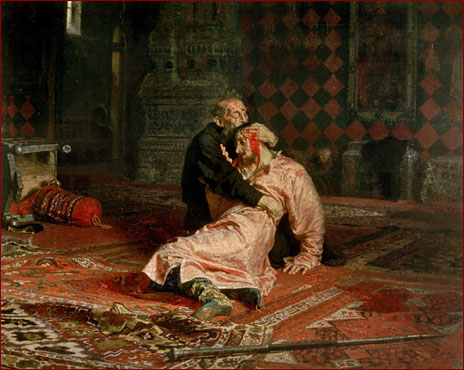
In 1581, Ivan beat his pregnant daughter-in-law for wearing immodest clothing, which may have caused a miscarriage. His son, also named Ivan, upon learning of this, engaged in a heated argument with his father, which resulted in Ivan striking his son in the head with his pointed staff, causing his son's (accidental) death. This event is depicted in the famous painting by Ilya Repin, Ivan the Terrible and his son Ivan on Friday, November 16, 1581 better known as Ivan the Terrible killing his son.
"The only lesson we ever learn is that we never learn"
Five years on, and still we have not learnt, writes the british jorunalist Robert Fisk about the invasion of Irak in The Independent. He complains about "Five years of catastrophe in Iraq and I think of Churchill, who in the end called Palestine a "hell-disaster". He is specially critic with is country, UK:
The Iraqi civilian death toll since the invasion is now greater than the total number of British military fatalities in the Second World War, which came to an astounding 265,000 dead (some histories give this figure as 300,000) and 277,000 wounded. Minimum estimates for Iraqi dead mean that the civilians of Mesopotamia have suffered six or seven Dresdens or – more terrible still – two Hiroshimas.
Pat Buchanan wrote not long ago: ""They drove the Brits out of Palestine and Aden, the French out of Algeria, the Russians out of Afghanistan, the Americans out of Somalia and Beirut, the Israelis out of Lebanon. We have started up the road to empire and over the next hill we will meet those who went before. The only lesson we learn from history is that we do not learn from history."Today, we are engaged in a fruitless debate. What went wrong? How did the people – the senatus populusque Romanus of our modern world – not rise up in rebellion when told the lies about weapons of mass destruction, about Saddam's links with Osama bin Laden and 11 September? How did we let it happen? And how come we didn't plan for the aftermath of war?
Oh, the British tried to get the Americans to listen, Downing Street now tells us. We really, honestly did try, before we absolutely and completely knew it was right to embark on this illegal war. There is now a vast literature on the Iraq debacle and there are precedents for post-war planning – of which more later – but this is not the point. Our predicament in Iraq is on an infinitely more terrible scale.
We have lost Afghanistan as surely as we have lost Iraq and as surely as we are going to "lose" Pakistan. It is our presence, our power, our arrogance, our refusal to learn from history and our terror – yes, our terror – of Islam that is leading us into the abyss. And until we learn to leave these Muslim peoples alone, our catastrophe in the Middle East will only become graver. There is no connection between Islam and "terror". But there is a connection between our occupation of Muslim lands and "terror". It's not too complicated an equation. And we don't need a public inquiry to get it right.
The Iraqi civilian death toll since the invasion is now greater than the total number of British military fatalities in the Second World War, which came to an astounding 265,000 dead (some histories give this figure as 300,000) and 277,000 wounded. Minimum estimates for Iraqi dead mean that the civilians of Mesopotamia have suffered six or seven Dresdens or – more terrible still – two Hiroshimas.
Friday, March 21, 2008
He was a dissident

His last television report on Channel One earlier this month was about the reconstruction of an Orthodox monastery in Abkhazia, a pro-Russian separatist region of Georgia, RIA Novosti news agency said. Today the body of Channel One correspondent Ilyas Shurpayev was discovered tby firefighters in his rented studio flat. A spokesman for the state-TV channel said a fire was apparently started there after the attack.A porter was quoted as saying Shurpayev had called down to her in the early hours to ask her to let two young men into the building.
More than a dozen journalists, including Anna Politkovskaya, have been killed in contract-style killings in Russia since 2000. Hate attacks on members of ethnic minorities from the Caucasus and former Soviet Central Asia are also common in Moscow.
Hours before his death, Shurpayev wrote a blog saying the owners of a Dagestan newspaper had banned his column and told its staff not to mention his name in publications. "Now I am a dissident!" was the title of the last entry in his web piece.
Critics say Russia has witnessed a steady rollback of post-Soviet media and political freedoms during President Vladimir Putin's eight-year presidency. Top independent television stations have been shut down and print media have also experienced growing official pressure, Pravda writes.
A planet called Užupis

Užupis is a district of Vilnius, located in the Old Town, which is a Unesco World Heritage Site. Its name means "on the other side of a river"; that river is the Vilna River which gave Vilnius its name. The region has been popular with artists for some time, and is often compared with Montmartre in Paris. Now the ruins there are becoming very expensive. "More expensive than an egg of a bishop", as we say in Spain. The district houses art galleries, artists' workshops, and popular cafés. The district declared itself an independent republic (the Republic of Užupis) in 199. Uzupis (in Polish: Zarzecze) is a place to love during the sunset. To walk during the daytime. And, just in case, to run at night.
The area unilaterally declared its independence on April Fool’s Day 1998, which is celebrated annually at the somewhat ramshackle Angel of Uzupis Statue. Is a bohemian place whose Constitution ends: "Don’t conquer. Don’t defend. Don’t surrender". Copies of the 41 articles of the Republic's constitution, in three languages, can be found affixed to a wall on Paupio street in the area. Some of these articles would be unremarkable in a constitution; for instance, Article 5 simply reads "Man has the right to individuality.". Others are more idiosyncratic. A typical example can be found in Articles 1 ("Man has the right to live by the River Vilnelė, while the River Vilnelė has the right to flow by man."), 12 ("A dog has the right to be a dog.") and 37 ("Man has the right to have no rights."), each of which makes an unusual apportionment of rights. There are a number of paired articles, such as Articles 16 ("Man has the right to be happy.") and 17 ("Man has the right to be unhappy.") which define man's right to either do or not do something, according to his desire.
Owen Lipsett, from Philadelphia wrote more about this corner of the world.
Congratulations to Ævar Guðmundsson, from Iceland, for this great photo. It was taken near a hostel were I slept in my last trip to Vilnius, a place I recomend.
The Volkovs: Take off in USSR and land in Russia. And now again...
 Sergei Volkov hopes to do as well as his father, a highly decorated Soviet-era cosmonaut, when he lifts off in a Soyuz rocket April 8. Sergei Volkov is the son of Alexander Volkov, 59, a veteran cosmonaut who logged up 391 days in space on three separate space missions in the 1980s and early 1990s. He was awarded an Order of Lenin and named a Hero of the Soviet Union for his performance.
The Soviet Union broke up in 1991. At the time Volkov was orbiting Earth on Mir with Sergei K. Krikalev,"the last citizens of the USSR ". Having gone into orbit as Soviet citizens, they returned to Earth as Russian citizens.
When Sergei returns to Earth, space tourist Richard Garriott, son of astronaut Owen Garriott will be aboard the same spacecraft.
Thursday, March 20, 2008
Dead or alive
A Russian-born American businessman disappeared under murky circumstances from his vacation house in Latvia. He is believed to be alive, the U.S. Embassy in the country said Wednesday to Moscow Times. Police began a massive search effort after a sport utility vehicle believed to belong to Rozhetskin was found abandoned in the city. Rozhetskin's private plane left Latvia in a hurry on Sunday, possibly without his consent, Latvian news agency Leta reported Wednesday, citing "unofficial information."
Friday, March 07, 2008
Мілена Куніс in Russia

Мілена Маркoвна Куніс was born in Kiev, Ukrainian SSR, Soviet Union (now Ukraine) to a Jewish family — Her parents moved to Los Angeles, California in 1991, Wikipedia says. Kunis learned English by watching 'The Price Is Right'; host Bob Barker spoke slowly enough for her to understand.She was cast in minor roles in children's programs and television commercials, appearing in a 1994 episode of Days of Our Lives as a young Hope Williams. She has been dating actor Macaulay Culkin for nearly six years. She is heterochromatic, which means her two eyes are different in color. One is blue while the other is green with a tint of brown.
Uncle Kuntz likes image manipulations. And so do I.
Subscribe to:
Posts (Atom)


Subscribe To


 Posts
All Comments


